Showing posts with label container gardening. Show all posts

Wednesday, May 27, 2020

Peppers, Potatoes, and Cherry Tomatoes

My vegetable garden has changed a lot in the past month!

A couple of weeks ago I planted the pepper seedlings I had started from seed. They were a little slow going this year. I started them around the 1st of March, but even by late April I wasn't sure they were ready to transplant yet. Then I realized I didn't have enough pots or potting soil, so I had to make a supplies run (and figure out curbside shopping). But they're finally planted.


My husband loves peppers and experimenting with different ways of using them. In addition to cooking with them, he has also pickled them and made his own hot sauce. Most winters I hand him the seed catalog and let him pick out what varieties of peppers he wants me to grow that year. Usually it's jalapeno peppers and then something weird. This year's seeds ended up being 'Mellow Star' Shishito peppers and a jalapeno variety called 'Jedi'. (He's a Star Wars fan. I had to.)


We've found from experience that hot peppers really thrive in large pots. Jalapenos, especially, love heat and sunshine. We've also learned that deer love pepper plants. So I started planting a large pot of each pepper variety and putting them out near the vegetable beds where they get lots of sun (but are more vulnerable to deer). The I plant a pot of each close to the house where they don't get as much sun (but where the deer will definitely leave them alone). That way, I'm guaranteed some measure of success.
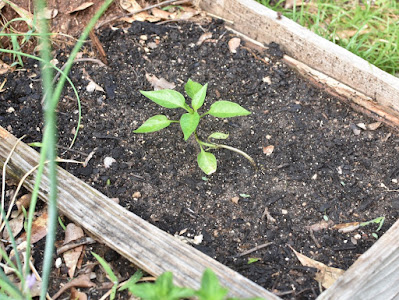

What little I could find on growing Shishito peppers suggested that they are used to cooler climates. I fear they won't tolerate our long, hot summers like jalapenos do. My vegetable and herb beds were pretty much full, but I found one space near the chives where I could make room for a Shishito pepper plant. Since the soil would be cooler in the ground, I am curious to see if that plant does any better than the ones in the pots. What can I say--the scientist in me is always collecting data.

In addition to peppers, I also started basil from seed this year. I had a ton of old basil seeds of various varieties from previous years--some as much as 5 years old. The germination rate goes down the longer they sit around, so I wasn't sure how many plants I would actually get. But I decided to clean out my seeds and just plant ALL of the basil seeds and see what happened. I ended up with a few more plants than I knew what to do with. I finally cleared a spot near the chives to plant a few, and just potted up the rest in small nursery pots I had, to either keep or give away.


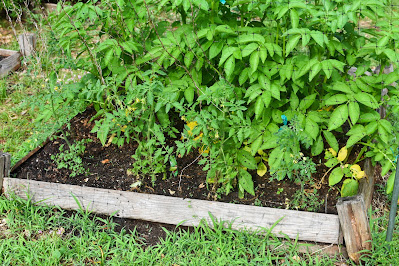
Meanwhile...boy have the other vegetables grown! The potatoes, especially, have kind of taken over.

Left to right: tomatoes, potatoes, bell peppers (somewhere under the potatoes), asparagus

The asparagus continues to send up new shoots every few weeks!

My tomatoes are still managing to grow while competing for space with the potatoes.

I even have baby cherry tomatoes.

And a baby zucchini! Look closely under the giant yellow flower.

Not all of my veggies have thrived this year though. I got a few tiny radishes, but maybe only half of them got large enough to even think about eating. Most of them were on the skinny side. The ones I did pick took about 5 weeks or so to mature. I picked the last of them over the weekend since the heat was setting in.

This radish was the roundest of all them--and the pinkest.

My bush beans have also been a struggle this year. About a third of the plants were eaten from the roots up and killed entirely by something tunneling. The internet tells me I have all the signs of voles, though I haven't seen them in person. The deer found the rest of the plants, and I discovered this scene one morning a couple of weeks ago:


I didn't think the fence would actually make a difference, or that deer would bother to walk through an open gate. (Our fence is not that tall. Larger deer can jump over if they really want to.) The fact that the bean plants got eaten after I left the gate open one night probably isn't a coincidence, though. I didn't give up on my beans entirely. I kept watering the leafless stalks to see what they would do, and over time they grew some leaves. They're stunted and will never be the same, but I did find a few small beans today!


All I can say is, I am thankful I am not actually dependent on my garden to feed my family. The world hasn't ended yet, and I can still find food at the grocery store. Anything I can harvest this summer will just be icing on the cake.

Thursday, May 7, 2020

Back to the Cottage Garden

While I've spent a lot of time on my vegetables this spring, the thing that really got me into gardening was the ornamental part of gardening. I love the beauty of gardens--from the flowers to the shrubs.

If you read some of my old posts, you'll see I spent a lot of time planting shrubs and perennials during those first couple of years in our house. I wanted a cottage garden look fitting of our English-style cottage. Since they come back year after year, they don't need quite as much attention as the vegetables, but they still need upkeep from time to time.

I spent much of my last two weekends working on some of the flower beds. I started on the rose bed in the very front. I planted two lavender plants there back in 2013. One of them died last year (or so I thought), so I bought another one. When I started cleaning out that bed though, I found that the lavender plant had started growing back from the nub that was left. I planted he new one in there anyways, hoping to fill out the bed a little more in between the two.

I thought this lavender plant was dead, and cut it back to a nub. It rewarded me with new growth this spring. Now I just need to keep the oregano from taking over.

I tucked the lavender plant I just bought back between the two old lavenders.

A side note about lavender. French lavender is notoriously hard to grow in most of the Southeast. It doesn't like our heat and humidity. If anyone wants to grow lavender here in Georgia, I recommend Spanish lavender--it tolerates the humidity much better. But I liked the look of French lavender better, and somehow, seven years later, it's still alive. I swear I found the right variety and the right location. I bought 'Munstead,' a dwarf lavender variety, from my favorite local nursery. I planted it against a retaining wall along the sidewalk, so it gets plenty of sunshine, good air circulation, and good drainage. The other secret: I water it as little as possible. Most of what it gets is rainfall and whatever runs down the hill. During the hot summer months, I'll water on particularly dry weeks. Somehow that formula has worked.

Lavender with the roses
In my garden I mostly tend to stick to perennials and shrubs, since they're a gift that keeps on giving. However I have a couple of spots in the front where I'll rotate through annual flowers to get an extra splash of color, and I'll usually plant a few in pots, as well. For this summer, I decided on lime green coleus, white fan flower, and this Calibrachoa whose color I just couldn't resist.


'Colorblaze Lime Time' Coleus

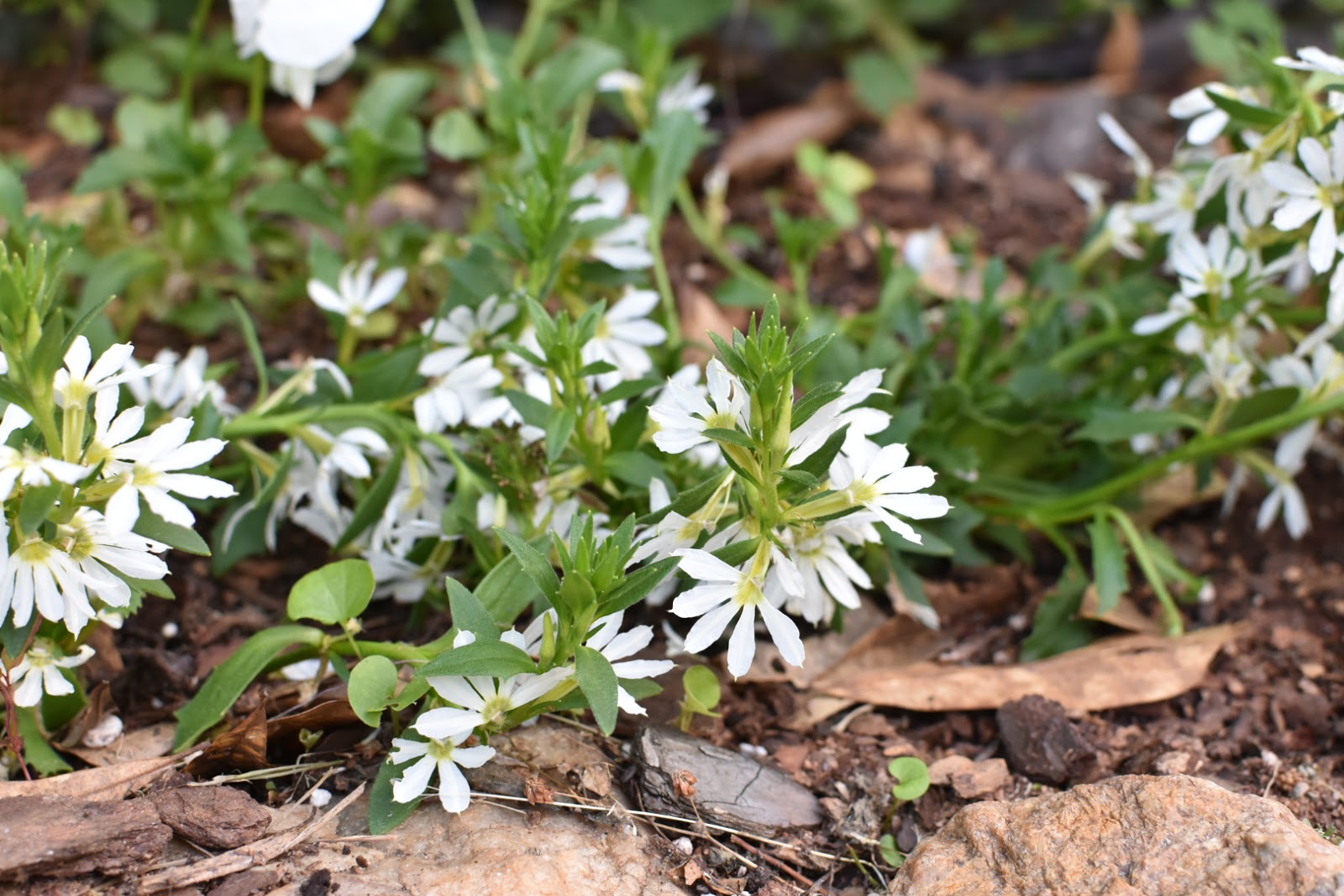
'Whirlwind White' Scaevola - also known as fan flower. I liked the upright growth habit of this hybrid.

'Superbells Holy Moly!' Calibrachoa
I find it hard to find flowers that will stay beautiful through our scorching summers, but I had good experience with coleus and fan flower in the past. Both manage to still look healthy in July and August. The calibrachoa was more of a toss up. Fingers crossed that it makes it. I also changed out one of my planters with a coleus and fan flower, plus this fuschia ivy leaf geranium I loved. Maybe it's because I spent so much time in Florida's Palm Beaches, but I think lime green and hot pink is a great summer color combination.


It's going to be good year for my roses. I never got around to giving them their annual pruning or fertilizer, but they look as happy as can be at the moment. I think it was because of all the rain we got this winter/spring. They just soaked it up and gave them a nice healthy start to the year. Even when plants look dormant, they're still "growing," it just looks different.

'Soaring Spirits' is looking particularly healthy this year.
Well, my work on the flower beds is far from over, so more on that soon!

Monday, March 24, 2014

A Pink Container Garden for the Pinkest Party


Here in Macon, GA, we're in the middle of the Cherry Blossom Festival. For those of you who don't know Macon, the Cherry Blossom Festival is a big deal. Their slogan is, "The Pinkest Party on Earth," and that might be accurate. Not only is the 10-day festival full of events such as concerts and parades, but you'll see almost everyone wearing pink. People even dye their dogs pink for the festival!

The cherry trees came through in full force this year, in perfect timing for the festival. The cherry tree in my backyard is looking its finest, as well. I decided in honor of the festival, and to celebrate the arrival of spring, I wanted a pink container garden for my patio. It didn't take long to run to Lowe's and put one together this weekend.


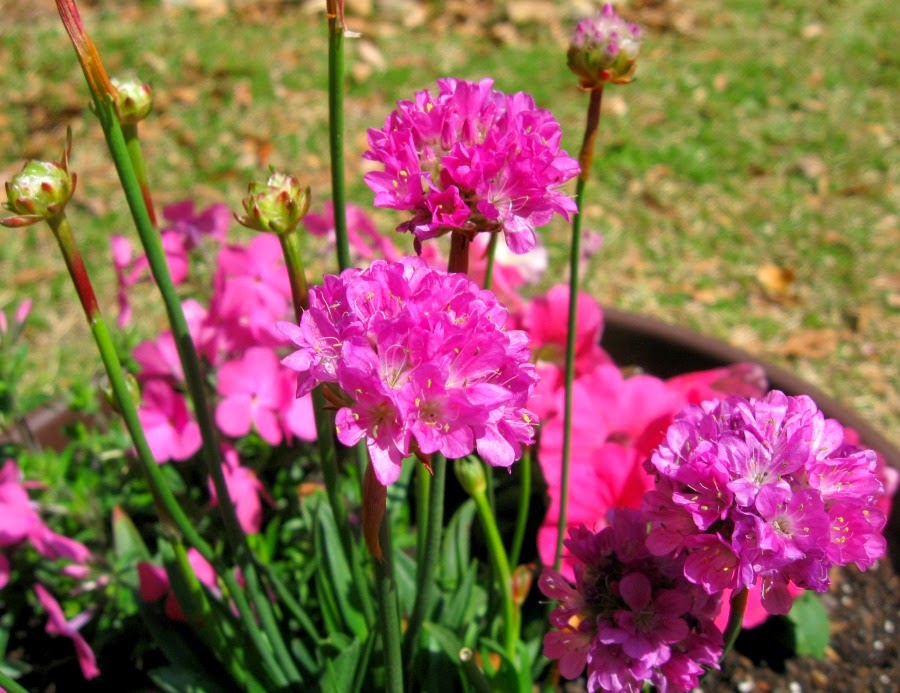
I picked three plants that I thought would give me the most bang for my buck: armeria, phlox, and petunias.

Armeria
Armeria is also known as thrift or sea pink. This perennial blooms spring and early summer, and can also be found in white or red. If you didn't guess from the name, it's native to coastal areas. It likes full sun and well-drained soil and is fairly drought tolerant. Even when it stops blooming, I think its grass-like foliage will be lovely in this container.

Phlox
There are several different species of phlox, but I loved the large blooms on this one. It's also a perennial, like armeria. It only blooms in spring, but I can plant it in my garden when it's done blooming. It likes full sun and regular water.

Petunia
When the phlox stops blooming, the petunias will fill in. These annuals are easy to grow, grow fast, and bloom all summer. They do best with regular water, but they'll survive a little neglect. I expect to see them spilling over the sides of my container in June. They don't tolerate frost, but I don't mind dragging the pot inside if we get a couple more frosty nights.

Happy gardening!

Thursday, May 16, 2013

My Patio Garden

From college until we bought our home last summer, my gardening was limited to windowsills, patios, and balconies. Even though I have plenty of ground to dig in around our new home, I continue to do a lot of container gardening on our patio. Some of the plants on our patio I've had for a few years. Others are recent additions. 


I've always loved herbs, and they're well-suited to pots. Some herbs I have simply because they smell nice, even though I have no idea how I'd cook with them (such as chocolate mint, lemon balm, and lemon-scented geranium). It's nice having them in arms-reach on the patio where I can enjoy their scent while relaxing with a cup of coffee in the morning.

Clockwise from top left: Strawberry, basil, rosemary,
jalapeno pepper, lemon-scented geranium, chives, and
lemon balm.

 It's nice to have the more useful herbs on the patio, too, for a quick snip while I'm cooking. Currently I have basil, chives, and rosemary there. I have some strawberry plants that I've grown in the same pot for a couple of years. They're not very fruitful, but it's fun to pick a fresh strawberry on my patio. I planted a jalapeno pepper plant in a pot upon request from my husband. He wanted to do an experiment to compare how they grow out in the raised bed versus how they do in a pot. I'll let you know how it turns out.


My godmother created this lovely seashell planter for me when I was in high school. I held onto it for years until I finally was able to decide what I wanted to plant in it and get around to putting it together. When I saw a remarkable collection of succulents for sale at Walmart last fall, I knew I'd found the perfect thing. The shallow planter dries out very quickly, but succulents don't need much water anyways. One of the plants died, but the others have more or less thrived.

'Knock Out' rose (left) and snapdragons (right) are in
bloom on my patio right now.

Normally I grow a lot of flowers in pots. I've been so busy with the rest of the garden, I haven't gotten around to planting all my summer annuals yet. I was given two Knock Out roses by friends last fall. I planted one in the ground, and the other I've decided to keep on the patio for now. The snapdragons I've had for a year and a half! I thought that they were supposed to be annuals (which means they should be dead by now). I didn't have any other plans for that pot, though, so I just cut them back when they looked sickly and they kept coming back. There's a Carolina jessamine in the lion planter next to the snapdragons that came with the house. It doesn't look like much now, but it had stunning flowers in February.

Camellia (left) and hydrangea (right) are happy in the
shade under the covering on my patio.

In addition to the rose, I have some other shrubs on my patio. I bought a camellia on sale a couple of years ago, and I thoroughly enjoyed its white flowers on my patio this winter. It won't grow very big in its little pot, but it's happy enough for now. I decided to keep one of my hydrangea cuttings on the patio this summer. It likes shade, and I can baby it while it gets a bit bigger and I decide where to plant it. Who knows, it might even bloom on my patio!

Some tips for container gardening in the South:
  • Buy good potting mix. It's worth the extra dollar for Miracle Gro brand.
  • Buy large pots, especially if you want to grow shrubs or vegetables. Smaller pots are fine for annuals or some herbs, but just remember: the smaller the pot, the more often you have to water it. In July, that can mean watering twice a day, depending on the plant.
  • Choose plants suited to how much sunlight your patio/balcony gets. (See my post Flowers Anyone Can Grow for more on how much light your plant needs). Patios and balconies usually get a lot of shade from the building and nearby trees.
  • In the summer, expect to water flowers, herbs, and vegetables once a day (unless you get rain). I've killed more plants just because I forgot to water them in the summertime (or went out of town for the weekend and didn't get someone to water my plants for me).
  • If you want really lush plants, fertilize regularly with a water-soluble fertilizer like Miracle Gro (either all-purpose, or one specifically for flowers, depending on the plant).


Vegetable Garden Update: It's been 33 days since I planted my vegetable garden, and I think it's looking lovely, don't you? We added a homemade trellis for the tomato plants (on the left side of the picture). I'm not sure the radishes are going to be edible. I remembered reading they have a really short harvest time, so I checked my book to see when they would be ready. It said 4 weeks from seed until harvest. It's been more than 4 weeks, so I kept reading until I found my answer:  "Don't let radishes stop growing or dry out;  lack of water causes hot-tasting and pithy radishes." I'm pretty sure I let the radishes dry out several times (hey, most plants like to dry out a little between waterings!), so that would explain why they're not getting fat and round. I'll have to try again in the fall (radishes don't like the heat of summer, either).