Thursday, August 15, 2013

The Beautiful Edible Garden

I finally got to spend some time cleaning up my garden this weekend. It was a busy weekend, but I took a free hour to pull weeds, remove dead plants, and do some light pruning. I hurt my back a couple of weeks ago, so I couldn't get in the garden until I recovered last week. When I finally checked on it there was a 3-inch-long tomato hornworm that had defoliated about 25% of my tomato plants. Fortunately, the vines were already huge to begin with, and the big, fat green tomatoes were untouched. But learn from me: check for tomato hornworms constantly before they get out of hand! If you keep an eye on your plants, there's no need to use chemicals, just remove the worms as you see them.

I had a hard time getting a good close-up of the giant
tomato hornworm, but you get the idea.

I'm delighted one of my lavender plants (which were kind of an experiment) has finally come into bloom. The red Flower Carpet rose behind it looks spectacular, too, so the front corner of my yard makes me smile every time I come and go.

Lavandula angustifolia 'Munstead' and 'Flower
Carpet Scarlet' roses bloom near the sidewalk.

I just finished reading The Beautiful Edible Garden by Leslie Bennet and Stefani Bittner. I am the sort of person who gardens more for the beauty than for the fruits and vegetables, but I also like the idea of harvesting my own home-grown produce (you can't beat a home-grown tomato). The title of this book intrigued me: the idea that I could have a beautiful garden and free vegetables in the same space. The colorful pictures on the cover were eye-catching, too:

The Beautiful Edible Garden by Leslie Bennet
and Stefani Bittner. Isn't it pretty?

The book was just as inspiring as the cover promised. The two authors outline the basic principles of designing a garden, and then go into detail on how to flesh that out in your various spaces: the front yard, back yard, side yard, and containers. They also cover basic principles of keeping your garden healthy and fruitful: soil preparation, light, water, fertilizer, planting techniques, tools, and more. To polish it off, they sprinkle the book with various indoor arrangements to make with a combination of flowers and edible plants, so you can enjoy the beauty of your garden indoors as well. Overall, the tone is practical, down-to-earth, and filled with specific examples.

I really enjoyed their many plant lists. They offer examples of edible plants that tolerate shade, that have low water requirements, that bloom in different seasons, or that lend themselves to different garden styles. They frequently refer to different kinds of fruits or unique varieties of vegetables or herbs that you would never see in a grocery store. It inspired me to grow my own food simply so I could try Fuyu persimmons, fresh chervil, or yellow wax beans. I loved the many pictures throughout the book; the pictures alone gave me ideas for my own garden.

The book is filled with lovely photos like these. I borrowed
these images from the authors' blog.

The one limitation to the book is that they frequently refer to tropical plants, such as citrus trees, that can't be grown year-round in Georgia (unless you want to bring them inside every winter). Likewise, for my Florida readers, they list plants like pear and apple trees that need cold winters. Before you get too excited about a specific plant, you'll want to double-check in your favorite plant book (or on the internet) to make sure it can grow in your climate.

In summary, if you want to get inspired to grow your own fruit, vegetables, and herbs in a unique setting, I highly recommend this book.

Sunday, August 4, 2013

Gardening Checklist for August

Now that the busyness of July is over, I've decided it's time to turn my attention back to doing more than just making sure my plants get enough water. Fortunately, they've been very forgiving of their neglect. I picked a little bouquet today from various things blooming in my garden.

A bouquet from my garden: zinnia (Cut & Come Again mix),
'Knockout' rose, 'Flower Carpet Pink Supreme' rose,
tricolor sage, and chocolate mint.

It's still too hot for most gardening tasks, of course. There's not much planting or fertilizing to do right now. But I know fall will come and go all too fast, so I want to get a head start on what I can do now. That way, I'll be prepared to enjoy the nice weather later. Here's my checklist for August:

1. Update my annuals. Not all annuals make it through the summer. My white petunia, for example, fizzled out on me for no real reason. If you live in the South, you can pull out your dead summer annuals and plant new ones now to get you through September (and probably October). This is also a good time to trim, deadhead, and prune back tired annuals for a new flush of blooms next month. While I'm at it, I also need to get back to fertilizing with bloom booster. That way, everything will look lush when I'm lounging on my patio in the fall.

My foxgloves still have a few blooms on them.
If I prune and fertilize, I could get a flush of
blooms in a few weeks.

2. Give my roses some TLC. That three-month rose fertilizer I used in April has been well used up by now, and my 'Knockout' roses are covered mostly in spent blooms. Fortunately, rose bushes can be cut back by as much as half now. The advantage of heavy pruning is that they'll put out new shoots with plenty of blooms. I won't have flowers for a few weeks after pruning, but I should have quite a show in September/October. I'll fertilize when I prune to get that extra boost of growth. I won't be able to do much pruning or fertilizing later in the fall or I'll risk an early freeze damaging new growth.

3. Plant fall vegetables. In the South, everyone loves to grow tomatoes and squash in the summertime, but they usually give up on growing vegetables the rest of the year. I'd like to try some fall vegetables.  Some summer vegetables may also be planted now for a late harvest. Here are a few things you can plant in August in Middle Georgia: bush beans, beets, broccoli, cauliflower, collards, cucumbers (after Aug. 20), kale, potatoes (before Aug. 15), and turnips. (If you're curious, here's a vegetable planting chart for Georgia with more details.) Since I'm planting in an existing bed, I'll add a handful of compost before I plant my fall veggies to replace the nutrients used up by my summer veggies.

4. Plan future beds. Fall is a great time to plant perennials and shrubs here in the South. In order to take full advantage of that narrow window of planting time, I need to map out my plan of attack now--which plants to move, where to add new beds, and what kinds of plants I want to try. I'll track the sun patterns in my planting areas (paying close attention to what gets the hot afternoon sun) and consider which of my plants have been most successful, so I might repeat them in other areas. If I do all my research now, I should have a good shopping list when I visit the garden centers in September. If I feel up to it, I might even start doing a little soil prep for my new beds.

While I was out assessing my garden, a butterfly landed on me. It's just
one of the little delights of gardening.

What are you most looking forward to in your garden this fall? Happy gardening!

Thursday, July 25, 2013

Lessons from July

I've hardly spent any time working in my garden this summer due to the non-stop rain. I've emerged a couple of times to get the weeds under control (particularly the tree seedlings that were blocking my view while trying to back out of my driveway), but I haven't spent the weekly time in the garden I should have (I think I even made a New Year's resolution about that...oh well). At least I haven't needed to water any of my plants. I think my plant-sitting friends secretly laughed at me when I asked them to keep an eye on my plants when I went on vacation. After all, why would it suddenly stop raining all the time like it had the previous month? I felt better knowing I had a back-up waterer, though.

In late July, when the heat and humidity are the worst, it's a good time to take a look at the garden and see what's worked this summer, and what hasn't. After all, wouldn't we all like a garden that looks beautiful in the middle of the summer with little or no effort from us? That's my dream, anyway. So here it is, what I've learned in July:

1. Spend time in the garden every week. The weeds are incredible. They love this rain. I would have a lot fewer weeds if I had just spent 30 minutes a week pulling some.

Is that a weed or a petunia? I'm not sure.

2. Mulch, and mulch some more. I didn't use nearly enough mulch in my garden. There are far fewer weeds where I applied the mulch good and thick. Where I only used a thin layer of mulch, I can hardly tell between the weeds and the garden plants.

I love how this border has turned out overall, but I need to
move my hydrangea somewhere else.

3. 'Twist-n-Shout' hydrangea does not tolerate direct sun. When I was planning the flower bed on the east side of my front door last fall, I carefully watched to see how much sun it got. At the time, the answer was none. I selected plants that could tolerate full shade. At the beginning of the summer, my 'Twist n' Shout' was covered in beautiful blue blooms. Some time in June the sun moved, and the hydrangea started getting hot afternoon sun. It's a sad, sun-burned mess. When fall comes, I'll have to transplant it to a spot in my backyard where I know it won't get any direct sun.

My Flower Carpet 'Scarlet' rose has flourished.
4. Winning plants: Verbena 'Purple Homestead,' 'Flower Carpet' and 'Knockout' roses, Hosta, Torenia, and Petunia 'Purple Wave'. Those are all plants that look lush and disease-free right now. I've always sworn by heat-and-sun-loving purple verbena for summer color. 'Knockout' roses are the recent Southern favorite for a carefree rose, but the 'Flower Carpet' roses I won have lived up to every disease-free, heat-tolerant promise. (See here for a picture of what it looked like when I planted it, and compare to the picture above to see how much it has grown.) You can't beat hostas for a lovely, shady groundcover in the summertime. This was my first time growing Torenia (aka wishbone flower), but both my blue and white Torenia have looked beautiful all summer in their part-shade flower borders (they love this rain). My white petunias (variety unknown) look all but dead, but my 'Purple Wave' petunias are doing just fine.

My hostas continue to flourish and spread.
Verbena 'Purple homestead' looks great down by the
sidewalk. Surprisingly, my lavender plants are still alive.
How is your garden doing right now? I'd love to hear which plants are working well for you this summer. Happy gardening!

Friday, July 12, 2013

The Fungus is Among Us

My little garden has been fairly productive, despite my hiding inside from the heat, rain, and mosquitoes. I emerge for a few minutes every couple of days to make sure everything's still alive, pick caterpillars off my tomato vines, and harvest the fruit of my springtime labors. I've continued to harvest some beans every week, and the cherry tomatoes have been tasty (I just have to make sure to harvest them while they're orange--by the time they're red the heavy rains have split the skins). My little sunflower just emerged in the vegetable garden this week, too.

I bought a sunflower "mix", so the color was a bit of a surprise.
What do you think of my little burgundy sunflower?
At the beginning of the summer I was worrying about my plants getting enough water in the heat of July. Little did I know that we would have record rainfalls! All that wet foliage is the perfect breeding ground for fungus, one of the many plant pests that can plague your garden.

I'm not talking about the mushrooms that might pop up in your backyard--those are usually harmless (to your plants, at least--I don't recommend picking one and eating it unless you're an expert). I'm talking about the fungi you might not even realize are fungi: blackspot on your roses, powdery mildew on your crape myrtles, and Botrytis on your strawberries. There are also the ones relatively unseen: the ones with crazy names (like Pythium and Phytophthora) that cause root rot, crown rot, and damping-off. From a distance it might look like your plant is dying for no reason, but upon closer inspection you'll see the real culprit.

I took a walk around my garden and discovered a few fungi affecting my plants.

Entomosporium is a common fungal disease
on Indian hawthorn.
The shot-hole fungus on my ornamental cherry
tree loves all this rain.
I'm pretty sure this is a type of fungal leaf
spot on my lemon balm.

I'm not sure what fungus is growing on my
potted palm. I'm hoping it's just feeding
on the dead leaves and won't hurt it.

As you can see, it's not always easy to identify the many fungal diseases that plague our plants. Unless you're a plant pathologist, though, it's not really necessary to know all of them. When I worked at the USDA Fruit & Nut Lab in Byron, GA, the plant pathologist I worked with would take samples of diseased pecan leaves and stick them in petri dishes to see what grew--a bacterial leaf spot or a fungal leaf spot, for example. If your plant looks diseased, the simple fact that we have so much rain makes fungus a likely candidate. So if you suspect fungus in your garden, here are some tips for treatment:

  • If the damage is mostly cosmetic, don't worry about it. Many fungi, like those pesky leaf spots on Indian hawthorn, won't kill your plant. I don't like to go overboard with the chemicals, so I tolerate a certain level of disease on my plants. It's not worth spraying my huge cherry tree when I know the fungus will go away come fall. That same leaf spot affects my lemon balm every summer, but the damage is always minor.
  • If the damage is minor, remove the infection. If there are spots on only a few leaves, remove the diseased leaves and throw them away (or compost them thoroughly). Clean up the fallen leaves under your plant where disease might be hiding. A lot of disease spreads by rain splashing off of existing infection.
  • If there are black spots on your rose, go buy a fungicide for roses. Now. Blackspot (yes, that's actually the name) is a fungus that plagues most roses. It not only causes black spots but yellowing and defoliation. It can make your beautiful rose bush ugly fast. Buy a fungicide for roses.
  • If the damage is significant, talk to a friendly professional. The nice people at your local garden center (not Home Depot or Lowe's) probably know a lot about plants. They can recognize powdery mildew in an instant, and they can recommend the best sprays for various diseases. If you don't know a good local garden center, look up your county extension agent. You can take a leaf sample down to their office, or snap a couple (close-up) pictures with your phone and e-mail it to them. They likely have a plant pathologist on staff who can ID it for you, and they'll tell you what to buy at Lowe's or Home Depot (or whether you should give up altogether and burn your plant to the ground).
  • If you're using a spray, follow directions. Read all that fine print. The time of day and weather conditions can greatly affect the effectiveness of your spray. You also want to pay attention to safety warnings (like "avoid contact with skin").
Whether or not you're battling fungus now, there are things you can do to prevent future fungal wars:
  • Amend your soil. There's not a whole lot you can do once your plant has root rot or crown rot except keep it from happening again. If you have heavy clay soil (common in the South), water won't drain well, and fungus can breed that can kill your roots. Mix in plenty of organic matter (such as compost) before planting to improve drainage. If you're gardening in pots, always use fresh soil (since old soil may be harboring disease) and make sure there's a hole in your pot so water can drain.
  • Buy disease-free plants. Buy your plants from reputable sources, and inspect them carefully before taking them home. You don't want to bring disease home with you.
  • Buy disease-resistant plants. If you don't want to spray for blackspot, there are disease-resistant varieties of roses you can buy. My 'Flower Carpet' and 'Knockout' roses, true to their care-free promise, have remained blackspot-free. My other roses have not been so lucky. It's the same with all kinds of plants--some varieties are more resistant to disease than others. When you're buying vegetables, read the seed packets to find disease-resistant hybrids.
  • Clean up your garden. Those fallen leaves may look like great mulch, but they're breeding grounds for fungus. Rake them up in the fall and either bag them or compost them. If you choose to compost, make sure they're good and decomposed before using the compost in your garden.
Happy gardening!

Wednesday, June 19, 2013

Plant of the month: Coleus

I must admit, between the rain, the heat, and traveling, I can't remember the last time I really worked in my garden (outside of watering, of course). Fortunately, all the rain we've had has kept my plants happy, at least. If I catch a break from the rain this weekend, I need to pull out some weeds that have also flourished with the extra water.

When I worked at Bellingrath Gardens in Mobile, AL, as a summer intern, they had an extensive coleus collection. The horticulture director had a particular fondness for these widely-varied plants and, since they root quite easily, he took cuttings every time he saw a new variety. That was when I realized how many unique and beautiful coleus hybrids there are.

The hybrid wasn't labelled when I bought my coleus, so
I'm not sure which kind it is. 'Wasabi', perhaps?

I bought this chartreuse coleus plant in April when it was just a little guy to fill in a temporary hole while I waited for my hydrangeas to fill out. A couple of months later, that little coleus is over 2 feet tall! It's actually slightly taller than my hydrangea next to it. I love how it brightens up this shady flower bed, even from a distance.

Coleus' foliage colors range from burgundy to green to yellow, depending on the hybrid. Leaf shape and texture range from smooth to ruffled. No matter your tastes, you're sure to find a coleus hybrid that pleases you. As they mature, they get flower spikes (usually tiny blue flowers), but most people prefer to cut off the flower spikes before they develop to keep the plant full and bushy. 

Coleus can be planted in the garden (like I did), or it can make a nice accent in a container planting with other flowers. If you're concerned about size, there are many varieties that don't grow as large as mine. Coleus mostly prefer some shade, but many newer varieties like full sun. Since it does like shade, it works well for patios and balconies (which are usually pretty shady). Coleus prefer a lot of water, but they're pretty tolerant. If it wilts, water it, and it will bounce right back.

The best part of coleus for the South is that it loves the heat. In subtropical climates like South Florida and Mobile, it can be grown as a perennial, but elsewhere it makes a great summer annual (it doesn't tolerate freezing temperatures). Since it roots so easily, I'll probably take a cutting in late fall and grow it on my windowsill to preserve it over the winter. You can root coleus just by sticking a cutting in a glass of water.

What are some of your favorite annuals?

Wednesday, June 12, 2013

Vegetable Garden Progress Report

I find it interesting that when I tell people in Macon I'm planting a garden, many of them assume I'm referring to a vegetable garden. For some people, that's the only kind of gardening worth spending time on. So this post is for all my vegetable gardening friends.

Since this is my first serious attempt at vegetable gardening in many years (and first major attempt in Georgia), it's sort of like an experiment for me. I planted a little of everything to see what worked and what didn't. It's been two months now, so I thought it was a good time to take stock of my garden's progress.

My vegetable garden on April 30, May 16, and June 12.

What's worked:
1. Bush beans. We got our first crop of beans this week. They came out slightly fuzzy, but otherwise tasty.

Our first bush bean harvest.


2. Cherry tomatoes. One of my cherry tomato plants has reached 6-7 feet tall. The other is almost 5 feet. They're full of little green fruit. The 'Rutgers' are chugging along. I've been removing all side shoots and tying it up to our homemade trellis. Can't speak to the harvest yet, but it's certainly resulted in really large plants.

3.  The cage. The cage my husband built to keep furry pests out of my garden has remained sturdy and mostly in place in spite of our doubts. Now I can watch the deer grazing in my backyard without wondering if they're going to devour my beans. It's also prevented squirrels from unintentionally digging up my carrots (they continue to dig around the tomatoes, but those plants are sturdy enough that they're unaffected).

Our cage doesn't look like much, but it keeps the larger
pests out.
4. Naturally pest-free. I haven't had any noticeable disease or insect problems yet. I like to attribute some of my good fortune to my feathered friends; I give them seed, and they hang around to supplement their diet with insects. Also, the surrounding woods have given us an abundance of ladybugs to take care of any aphids that appear (I should know, the ladybugs were hibernating in my house over the winter). I attribute the lack of disease to the fresh soil mix I used and to the lack of nearby plants to introduce diseases (my vegetable bed is off in a corner by itself). Also, fewer insects=fewer diseases.

What needs improvement: 

1. Radishes. The radishes sprouted and matured but never really developed into edible radishes. Apparently they like a lot of water. I did not give them a lot of water.

2. Number of bean plants. I should have planted more beans. I will only get about one meal's worth of beans out of these plants (enough for me and my husband), and then they'll stop producing. I planted 8 bush bean plants this year. I'll probably do 16 next year, perhaps staggered (8 to start, 8 more 2 weeks later).

The bush beans and onions are competing for space.

What's still in progress:
Everything else looks healthy. The carrots, onions, okra, zinnia, sunflower, and bell pepper plants are growing slowly. The jalapeƱo plant has tiny fruit on it.

A couple of jalapenos are almost ready to pick.
If you have a vegetable garden, I'd love to hear about it! There are plenty of things I haven't tried yet--like squash and cucumbers. And I have yet to see whether I'll get a good crop from most of my plants, so I'm open to suggestions. What are you growing? What's worked? What hasn't?

Tuesday, June 4, 2013

5 Tips for Watering Your Plants This Summer

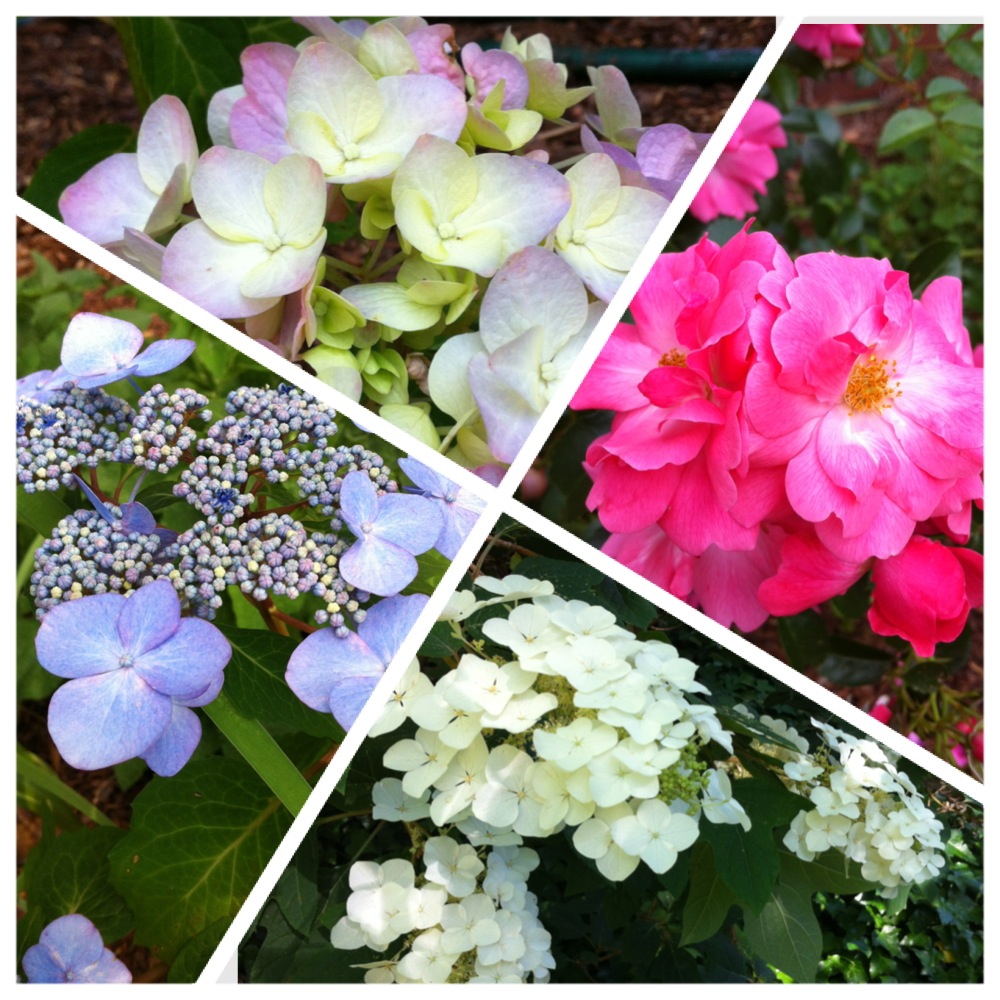
It's officially summer here in Georgia. Temperatures have reached the 90s, and both my hydrangeas and Flower Carpet roses have started blooming.

Clockwise from top: Hydrangea (variety unknown), 'Flower Carpet
Pink Supreme' rose, oakleaf hydrangea, and 'Twist n' Shout' hydrangea

The summer heat means it's time to turn our attention to watering. Lack of water (or sometimes too much water) is one of the leading causes of plant death. I've killed more plants than I can count simply because I went out of town for a long weekend in July, left my plants out on the balcony, and didn't get a plant sitter. (Fortunately I have two excellent plant sitters now, so my garden is in safe hands when I travel.)

Here are some tips for properly watering your garden this summer:

1. Water your flowers and and herbs after the top inch of soil has dried out. Just stick your finger in the soil to determine if it needs to be watered. Of course, some plants (like impatiens) like more water and others (like verbena) like less, so it always helps to know the specific needs of your plant.

2. If you can, water early in the morning. This practice has a couple of benefits. For one, you reduce plant diseases. If you water late in the day, water on the leaves doesn't have time to evaporate and just sits overnight. Wet leaves are the perfect breeding ground for fungus. Secondly, if you're using a sprinkler, you waste less water. If you water in the heat of the afternoon, much of the water evaporates before it reaches your plants.

3. Don't let your vegetable plants dry out. Lettuce, radishes, bell peppers, beans...they all like constant moisture for the best harvest. Hot peppers are one exception--they like to dry out between waterings. Be careful with overwatering your carrots and tomatoes as it gets closer to harvest--a sudden influx of water will cause the carrot or tomato fruit to split.

4. Give your lawn an inch of water a week. Some weeks they may get this from rainfall, other weeks you'll need to put a sprinkler out. You can get a container like a soup can and mark one inch from the bottom with a permanent marker to make a cheap rain gauge. Leave it outside, and if rain hasn't filled your can to the line by the weekend, water your lawn until it does reach the one-inch mark.

5. If you planted any trees or shrubs this spring, they also need an inch of water per week. Make sure they get regular water through the hot summer and into fall. Established trees and shrubs will benefit from extra watering during a drought, but otherwise can be left alone.

Happy gardening! What's blooming in your garden this month?